In international logistics, damaged cargo does not always arrive at the consignee in the form in which it left the sender’s warehouse. Sometimes the damage occurred in transit, the packaging was opened, part of the tare was replaced, the cargo was shifted to another pallet, or its appearance was restored before further transportation. As a result, the consignee sees the already altered condition of the cargo and may not know what happened to it earlier.
This is exactly where one of the most difficult tasks in investigating transport losses arises. If the packaging was subjected to repackaging, a simple inspection of the goods upon acceptance may not be enough to determine the moment and circumstances of the damage. A new box, fresh stretch film, or different tape can hide the initial traces of impact and simultaneously create new questions: who opened the cargo, why was it done, when did the intervention occur, and in what condition were the goods prior to it.
Therefore, repackaging traces are not a secondary detail, but an important element of the evidence base. Their proper documentation helps reconstruct the history of the cargo’s movement, compare the actual condition with the documents, and determine at what stage damage, shortage, or other non-compliance could have occurred.
What is cargo repackaging
Repackaging is usually understood as altering the initial packaging of the goods using new or additional packaging materials. This can be a complete replacement of the tare, partial restoration of a damaged box, re-wrapping a pallet with film, taping an opened package, or moving the contents into another tare.
At the same time, it is important to distinguish repackaging from a normal technological operation. At the warehouse, the cargo can be additionally secured with film, placed in transport packaging, or protected from external impacts in accordance with an established procedure. The mere fact of having multiple layers of packaging materials does not mean that the cargo was subjected to hidden intervention.
The question arises when the actual condition of the packaging does not match the expected condition of the cargo at a specific stage of the route. For example, the sender’s documents specify one packaging design, but a different one is found upon acceptance, and the boxes show signs of re-taping or new labels. Such a difference already requires additional analysis.
Why repackaging matters for an investigation
Imagine a situation: the consignee discovers damaged goods inside an externally intact box. The carrier claims to have received the cargo without damage, and the sender claims to have shipped intact products. At first glance, establishing the moment the defect occurred is practically impossible.
But upon closer inspection, it turns out that the box is sealed with a different type of tape, there is an additional label over the original transport marking, and the pallet uses a film different from the one used by the sender. These details do not automatically prove the guilt of any participant, but they significantly change the direction of the investigation.
Now there is a need to find out where and when the packaging was changed. Perhaps it was opened for customs control, perhaps it was restored after mechanical damage, or perhaps the repackaging was carried out at an intermediate warehouse. Each option has its own consequences for the distribution of liability.
Repackaging can hide initial damage
One of the main problems is that new packaging can physically remove or disguise part of the traces of the initial event. A damaged box can be replaced, a tear taped over, a pallet re-wrapped with film, and the contents moved to an intact tare.
As a result, during normal acceptance, the consignee will see not the initial condition of the cargo, but an already altered object. If no one recorded the repackaging process, proving that the damage existed before this operation becomes much more difficult.
Situations where repackaging is carried out without drawing up a report and without photographing the initial state are especially dangerous. Later, the participants may describe what happened differently, and there will be no objective materials to verify these versions.
What traces repackaging can leave
Repackaging rarely passes absolutely without a trace. Even if the cargo’s appearance seems neat after restoration, a careful inspection can reveal differences between the initial and later packaging materials.
A surveyor assesses not a single element by itself, but a combination of signs. New film without other discrepancies may be a normal warehouse operation, whereas a combination of new film, different tape, a damaged old label, and tampering traces already requires a more detailed investigation.
During inspection, special attention may be paid to the following signs:
- differences between packaging materials on the same batch;
- additional layers of tape or film;
- traces of removed old labels;
- re-glued marking signs;
- damaged or replaced seals;
- different dates and numbers on the packaging;
- traces of opened boxes;
- deformation of the tare under new packaging material;
- non-compliance of packaging with the sender’s standards;
- differences between pre-shipment and acceptance photographs.
This set of signs is not universal proof of repackaging. Its task is to identify points that require comparison with documents, photographs, and testimonies of the logistics chain participants.
Why a single sign is not enough
The most common mistake when investigating repackaging is turning an indirect sign into a final conclusion. For example, the presence of new tape does not mean someone opened the box after shipment. The warehouse could have used a different material to additionally secure the cargo.
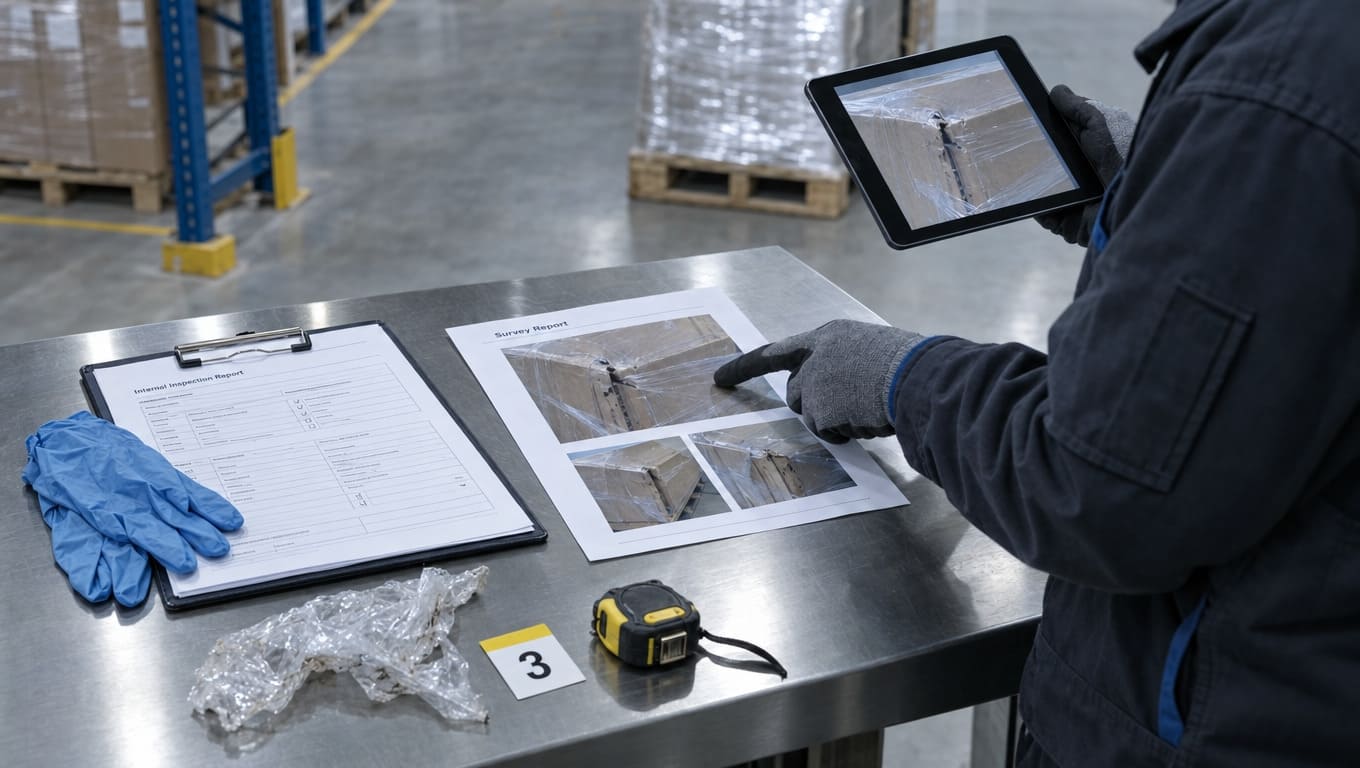
Therefore, professional documentation must answer not only the question “what looks unusual”, but also the question “what exactly was observed”. The surveyor records the packaging’s appearance, nature of traces, markings, position of elements, and other objective circumstances, and then compares them with available data.
A cause-and-effect relationship should be built on a combination of information. The more serious the alleged damage, the more dangerous it is to draw a conclusion based on a single visual sign.
Packaging inspection begins before opening
If cargo is suspected of being damaged or repackaged, the first stage should be an inspection in the state in which it was found. You should not immediately remove the film, open boxes, or move items if there is an opportunity to first record the initial state.
This is fundamentally important because after opening, some evidence will be lost. Removed tape cannot be re-presented in its original position, and removed film will no longer show the nature of its application.
Therefore, before any manipulations, the general appearance of the cargo, item arrangement, condition of the pallet, film, boxes, tapes, seals, and markings are recorded. Such an order creates a starting point for further investigation.
How to photograph repackaging traces
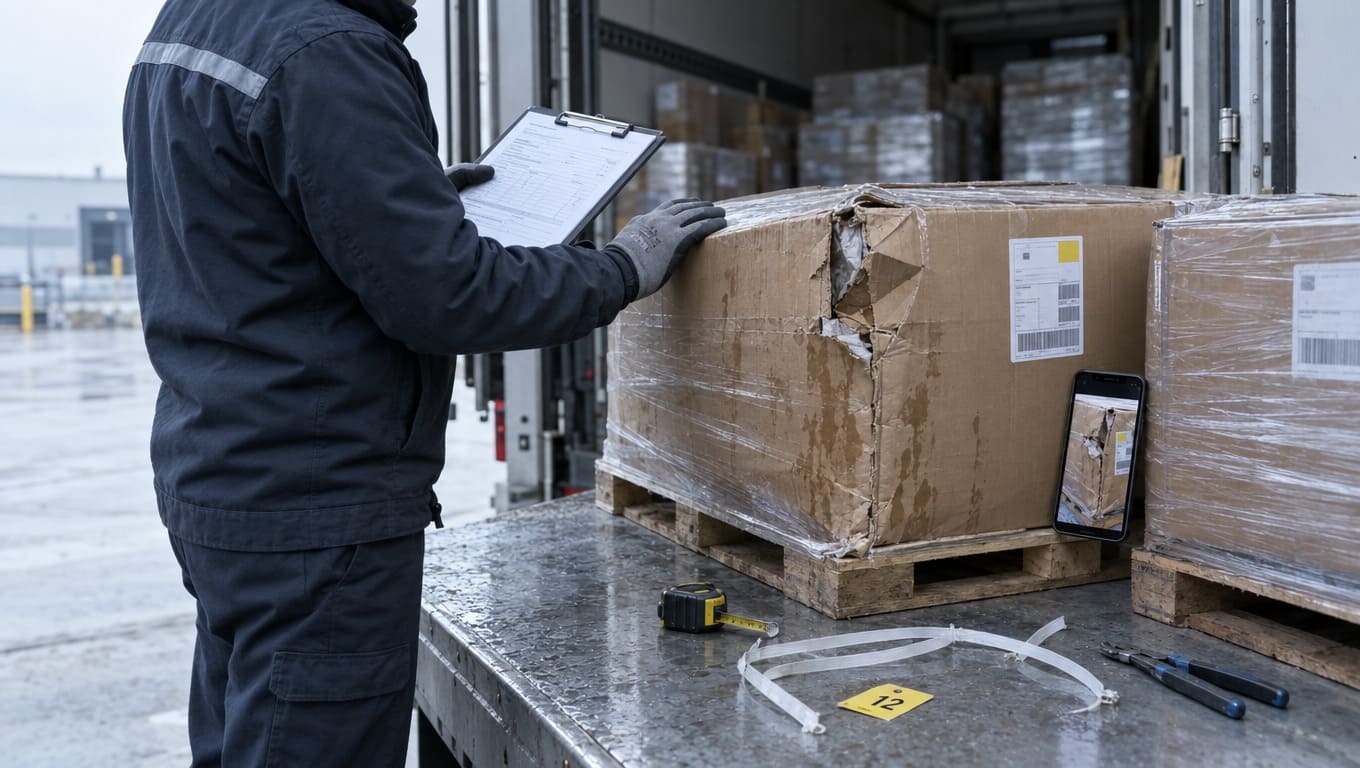
A photograph should not simply show a damaged box, but allow understanding exactly where it was located and what exactly was found. A single close-up of torn tape rarely has sufficient evidentiary value without the general context.
It is usually advisable to combine a wide shot, a medium shot, and detailed photography. The wide shot should clarify the cargo’s location, the medium shot – a specific item or packaging unit, and the detailed shot – features of the tape, film, seal, label, or damage. It is important that the photographs allow comparing details with each other. An item number, batch marking, or pallet identifier helps link a specific trace to a specific packaging unit.
What is recorded in the wide shot
A wide shot shows the cargo’s condition before the detailed inspection begins. It helps establish how many items are on the pallet, how they are arranged, where the suspicious packaging is located, and what the cargo looks like overall.
If on one pallet some boxes are wrapped with one film, and some with another, this is already visible at the general level. Similarly, you can detect pallets of different types or areas where the packaging clearly differs.
Such a photograph is particularly useful for large batches. Without it, a single photograph of a box can lose context, and later it will be harder to prove that it belonged precisely to the investigated delivery.
Detailed photography of packaging materials
The next level is recording specific signs. Here, not only damages are important, but also features of the materials covering the cargo.
The surveyor can photograph the tape’s width and color, presence of logos or inscriptions, film winding direction, number of visible layers, nature of material overlap, and joint locations. If there are traces of old tape removal, they must also be recorded.
Areas where one material sits on top of another have special value. In such zones, it is sometimes possible to determine the sequence of packaging application, although a final conclusion must be made taking into account other circumstances.
Markings tell the cargo’s history
Labels and marking signs are often underestimated during an investigation. Meanwhile, they can show that the packaging was changed or moved between different stages of the logistics chain.
A box may contain production markings, a transport label, a warehouse sticker, a customs sticker, a carrier identifier, and additional designations. Their location and condition can help establish the sequence of operations.
For example, if one label is partially covered by another, this is not automatic proof of a violation. But if a later warehouse label appears over the original marking, and the tare itself differs from the initial photographs, a basis for a more detailed comparison emerges.
Traces of old labels
When replacing or restoring packaging, old markings might not be completely removed. Sometimes areas of the adhesive layer, tear marks, paper fragments, or surface discoloration remain.
It is important to photograph such details before cleaning the packaging. After removing adhesive residue or the old label, some information may disappear.
At the same time, objectivity must be maintained. A label trace shows that another element might have previously been in this place, but does not independently answer the question of who removed it and when.
Tape as a source of information
Different participants in the logistics chain may use different packaging materials. The manufacturer may use branded tape, the warehouse – plain transparent tape, and the carrier or terminal – reinforced material.
If a single box has several varieties of tape, this may be a normal result of a repair. But if one layer clearly covers another, and traces of damage to the old tape are visible under the new one, the sequence of operations becomes an important object of investigation.
When recording, it is necessary to show not only the tape itself, but also its contact area with the original packaging. It is exactly there that the most informative signs are often found.
Stretch film and pallet re-wrapping
Film on a pallet can be applied several times during a logistics route. This in itself does not indicate a problem: the cargo could have been additionally secured before transportation or after a warehouse operation.
However, sometimes new film hides damaged boxes or shift traces. Therefore, if repackaging is suspected, it is important to first photograph the entire pallet and only then proceed to remove the film. Special attention is paid to the nature of the winding. Uneven density, differences between layers, local areas of additional reinforcement, and non-compliance with the standard packaging scheme can become additional signs for analysis.
A seal as an element of chronology
A seal is important not only as a means of protection, but also as an identifier of the cargo’s specific condition. If a container or vehicle is sealed, the seal number and its condition must be recorded. When a new seal is found, it is important to find out which seal was installed originally and who had the right to replace it. If the previous number is indicated in the documents, but a different one is actually installed, a specific question arises about the place and circumstances of the change.
But even a broken seal does not automatically prove damage or shortage. This is a fact of a change in cargo access status that must be compared with documents and route events.
Internal packaging is sometimes more important than external
Even if the external box was replaced, elements of the original packaging may be preserved inside. These can be branded inserts, protective materials, individual bags, pads, fasteners, or markings.
Their condition can show whether the contents were subjected to impact, shifted inside the tare, or re-stowed. If internal elements are arranged differently than stipulated by the manufacturer’s technology, this can also matter.
Therefore, a full inspection should not automatically end at the external box. If necessary, the internal packaging structure must be examined, observing the order of recording each opening stage.
How to record cargo before and after opening
Before opening the packaging, it is important to record all available identifiers. This makes it possible to accurately link photographs of internal damage with a specific item later. Box, pallet, container, seal, and batch numbers and other designations are recorded if they are available. It is advisable to sequentially photograph the external appearance of every significant object before its condition is altered.
After opening, attention shifts to the contents and the inside of the packaging. It is important to determine whether the actual placement of the goods matches the expected layout.
If goods are shifted, damaged, missing, or show signs of mechanical impact, their position relative to the packaging must be recorded. This can help understand whether the damage is related to transport impact or occurred during another operation. If signs of impact inside the box, deformation of protective elements, or destruction of internal fastenings are found, they should also be photographed. Together, these signs can help reconstruct the damage mechanism.
Which documents help establish the fact of repackaging
The physical condition of the cargo must be compared with its documentary history. The more independent sources describe the original appearance of the packaging, the easier it is to detect changes.
The following can be used for the investigation:
- packing lists and specifications;
- waybills;
- acceptance and transfer acts;
- warehouse documents;
- transshipment documents;
- damage acts;
- customs inspection records;
- sender’s photographs;
- carrier or terminal photographs;
- seal data;
- documents on repackaging or tare repair.
Documents are particularly important because visual inspection shows the current state, and documents help reconstruct previous stages. Comparing them allows determining where a discrepancy arose between the two states.
How to distinguish repackaging from normal warehouse handling
Warehouse operations often change the cargo’s appearance. A pallet can be additionally wrapped with film, a box reinforced with tape, a new label applied, or several items consolidated into a transport unit.
Therefore, you cannot build an investigation on the principle of “new tape means repackaging after damage”. It is necessary to know the standard procedure of a specific warehouse or sender and compare the actual condition with it.
If a certain type of additional packaging is a routine operation, its presence should not be presented as a suspicious circumstance. Conversely, a deviation from the established procedure can have much greater significance.
Typical mistakes when recording repackaging
Mistakes at the initial inspection stage can seriously weaken the subsequent evidence base. Sometimes parties to a dispute believe it is enough to take a few photos of a damaged box, but a few days later it turns out to be impossible to determine which pallet it belonged to and exactly when it was taken.
The problem occurs especially often when people start disassembling packaging before documenting it. After removing the film or tape, some of the initial signs can no longer be restored.
The most common shortcomings include:
- lack of photographs prior to opening;
- lack of identifiers for a specific item;
- shooting only a damaged detail without a wide shot;
- lack of photos of seals and their numbers;
- lack of data on inspection time and place;
- destruction of removed packaging materials;
- lack of comparison with original photographs;
- confusing a repackaging fact with an assumption about the guilty party;
- lack of documentation of internal packaging condition;
- failure to reconcile physical quantity with documents.
Each such mistake may seem insignificant at the time of inspection. But when a dispute arises, it is precisely from these details that the question of how convincingly the cargo history can be reconstructed is formed.
Why independent documentation is important
When parties are already arguing, each of them may perceive the same circumstances differently. The consignee speaks of damaged packaging, the carrier says they received the cargo in sound condition, and the warehouse reports on completed repackaging.
In such a situation, an independent inspection is especially useful. A specialist records the actual cargo condition without needing to pre-accept the version of one of the parties.
As part of surveying services, the condition of cargoes and their compliance with declared characteristics are checked, including before dispatch, upon receipt, or during transportation. The company also indicates quantity and quality control, photo and video shooting during loading, unloading, and at warehouses.
The LVS Global group of companies provides surveying and inspection services, including checking cargo condition during loading, unloading, and at warehouses, photo and video recording, and quantity and quality control. The company’s website also features services for damage expertise, damage assessment, and loss settlement. If you need to record repackaging traces, establish the actual cargo condition, or collect materials for subsequent transport loss investigation, please contact us! The earlier the initial packaging condition is recorded, the easier it is to reconstruct the cargo history later. And the more accurately this history is reconstructed, the more objectively one can determine at which stage damage or shortage occurred and which logistics chain participants should be responsible for the consequences.